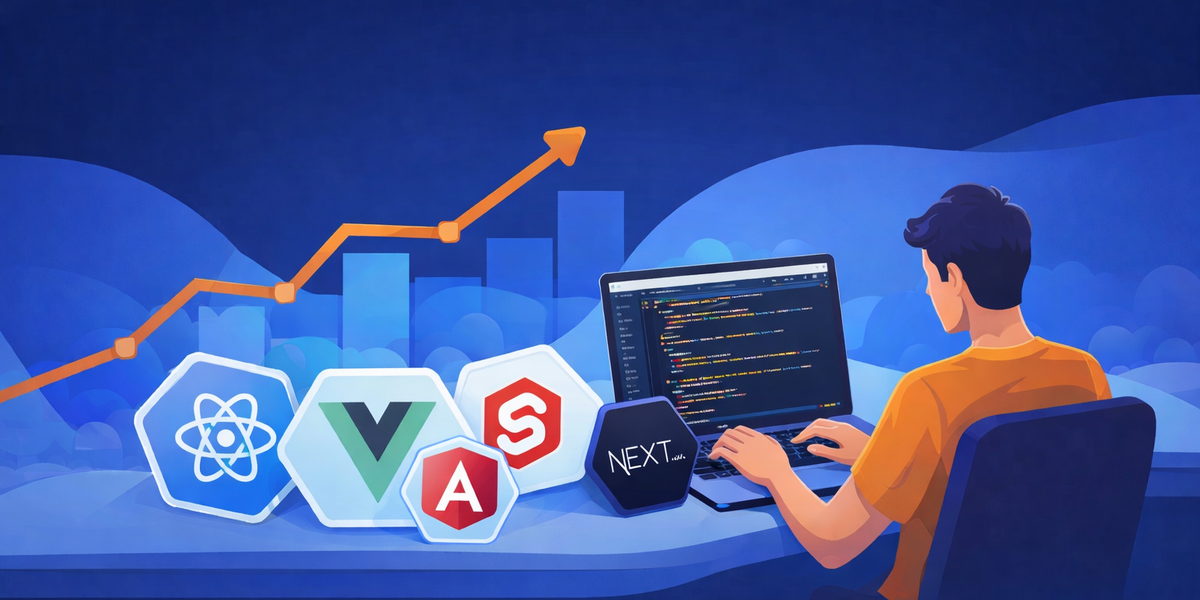
Frontend development in 2026 looks very different from what it was just a few years ago. Frameworks are no longer just tools to build user interfaces—they have evolved into complete application platforms that focus on performance, scalability, AI integration, and developer productivity.
Let’s explore how major frameworks have evolved till 2026 and what this evolution means for developers and businesses.
The Big Shift: From UI Libraries to Application Platforms
Earlier, frameworks mainly focused on DOM manipulation and UI rendering. By 2026, the priorities have shifted toward:
- ⚡ Ultra-fast performance with minimal JavaScript
- 🤖 Built-in AI readiness (testing, refactoring, suggestions)
- 🌐 Server-side rendering (SSR) and edge computing by default
- 🧠 Better developer experience (DX) with less boilerplate
- 📈 Scalability for both startups and enterprises
This shift has redefined how modern web applications are built.
🚀 React’s Evolution Till 2026
React started as a simple UI library, but by 2026 it has transformed into the core of a powerful ecosystem.
What Changed?
- Introduction of Server Components reduced client-side JavaScript
- Concurrent Rendering improved responsiveness in large apps
- The React Compiler automated performance optimizations
- Tight integration with AI-powered developer tools
- Seamless usage with frameworks like Next.js
2026 Impact
React is now a preferred choice for:
- SaaS products
- AI-powered dashboards
- High-traffic consumer applications
React in 2026 is flexible, future-ready, and backed by the strongest ecosystem in frontend development.
🏗️ Angular’s Evolution Till 2026
Angular has gone through one of the biggest transformations.
What Changed?
- Shift to standalone components, reducing complexity
- Less boilerplate and faster development cycles
- Improved rendering performance with fine-grained reactivity
- Deep TypeScript integration for long-term code safety
- AI-assisted testing, debugging, and refactoring tools
2026 Impact
Angular remains the top choice for:
- Large enterprises
- Financial and healthcare systems
- Applications requiring strict architecture and consistency
Angular in 2026 is cleaner, lighter, and still enterprise-grade.
🌿 Vue.js Evolution Till 2026
Vue.js continues to be the perfect balance between simplicity and power.
What Changed?
- Strong adoption of the Composition API
- Improved scalability for medium-to-large applications
- Faster builds and dev servers powered by modern tooling
- Better SSR support and ecosystem maturity
2026 Impact
Vue is widely used in:
- Startup products
- Content-heavy platforms
- Rapid MVP development
Vue.js in 2026 is developer-friendly, flexible, and highly productive.
⚡ Svelte’s Evolution Till 2026
Svelte represents a fundamentally different approach.
What Changed?
- Shift from runtime-based rendering to compile-time optimization
- Extremely small bundle sizes
- Near-native performance without virtual DOM
- Growing ecosystem and real-world adoption
2026 Impact
Svelte is preferred for:
- Performance-critical applications
- Lightweight dashboards
- Mobile-first and embedded UIs
Svelte in 2026 is the performance champion with minimal overhead.
🔮 Key Framework Trends by 2026
Across all frameworks, some common trends dominate:
- 🤖 AI-first development is standard, not optional
- 🌍 Edge computing & SSR are default strategies
- 🧩 Modular architecture replaces monolithic setups
- 📉 Less JavaScript shipped to users
- 🎯 Focus on both developer happiness and user experience
Frameworks are no longer competing only on features—they compete on how fast teams can ship reliable, scalable products.
Final Thoughts
By 2026, choosing a framework is less about popularity and more about project goals:
- Need flexibility and ecosystem power? → React
- Building enterprise-scale systems? → Angular
- Want speed with simplicity? → Vue
- Chasing maximum performance? → Svelte
The evolution of frontend frameworks shows one clear direction: smarter tools, faster apps, and better developer experience.