
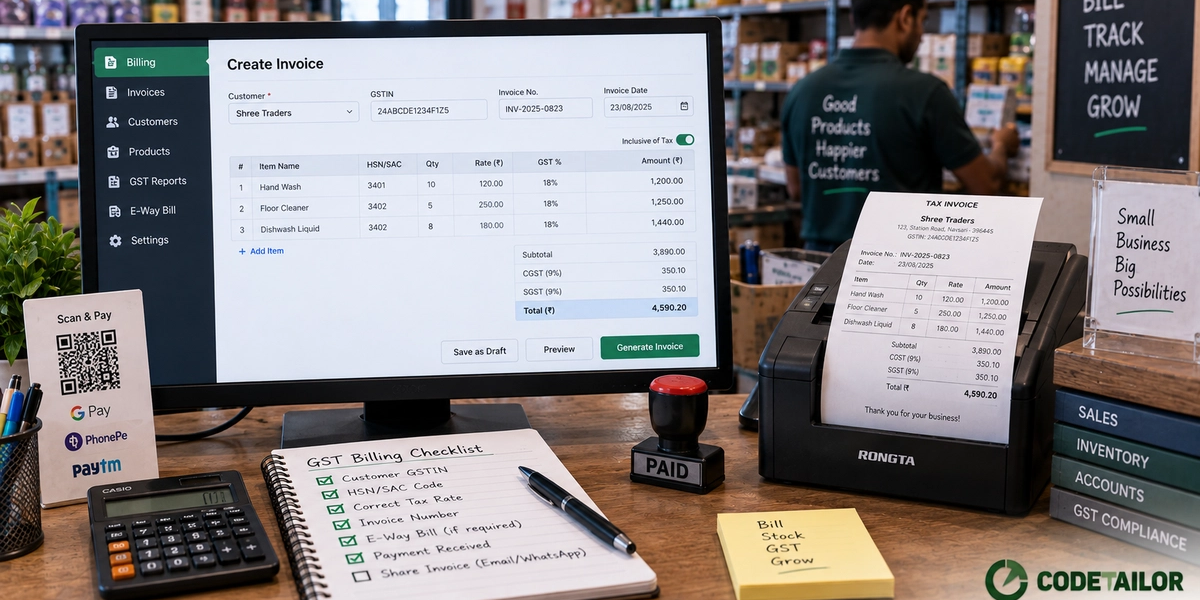
Everything prints an invoice
Every product in this category can produce a tax invoice with a GSTIN on it. That is not where they differ, and it is not where the money is either.
The differences show up in three places: at filing time each month, at year end, and on the day you decide to move to something else. All three are invisible during a demo.
Here is what to look at instead.
Does the data come out cleanly?
Start here, because it constrains everything after it.
Ask for a full export of your own data in a format you can open — invoices, customers, items, tax breakups, payments. Not a PDF report. Something a spreadsheet or another system can read.
If the answer is that support can arrange it on request, treat that as no. Data you cannot get out on your own is data you do not fully control, and every year you stay makes leaving more expensive.
This applies to free and paid products equally. It is the single most useful question in this post.
Does it match how you actually invoice?
Most software assumes a straightforward sale: item, quantity, rate, tax, total. Real billing has awkward cases, and it is worth testing them before buying rather than after:
- Discounts — line-level, invoice-level, and the difference between one applied before tax and one
after - Freight, packing and other charges, and whether they attract tax correctly
- Advances received, and adjusting them against a later invoice
- Sales returns and credit notes, properly linked to the original invoice
- Reverse charge, if it applies to you
- Multiple rates on one invoice
- Interstate versus intrastate handled automatically from the place of supply rather than by someone
remembering
Take your five most complicated invoices from last year and reproduce them in the trial. That test finds more than any feature list.
Will it still be right at filing time?
The purpose of the software is not the invoice. It is that the month's figures reconcile without someone rebuilding them by hand.
Ask:
- What does it produce for GSTR-1, and in what format?
- Can it be compared against the purchase side so mismatches are visible before filing rather than
after? - What happens when an invoice needs amending after the return period has closed?
The last one matters more than people expect. Software that lets someone edit a filed invoice silently is not being flexible; it is creating a discrepancy nobody will find until a notice arrives.
E-invoicing and e-way bills
Both apply above thresholds that have been revised more than once — <current threshold — verify> — so the useful question is not whether you need them today but how much work it is when you do.
The good answer: the software already supports it and it is a settings change. The bad answer: it is on the roadmap, or requires a different plan, or is a separate tool your staff use alongside this one.
If you are anywhere near the current limit, choose as though you have already crossed it.
The things that decide daily life
- How fast is one invoice? For a counter or a busy dispatch desk, this dominates everything else. Keyboard-first entry beats a beautiful interface that needs a mouse.
- Does it work when the internet does not? Cloud-only billing is a real risk if your connection is unreliable. Ask what happens during an outage — whether billing stops or queues.
- Who can do what? A biller should not be able to delete invoices or change rates. If everyone shares one login, you have no audit trail and no way to answer questions later.
- Printing on your stationery. Pre-printed letterheads, specific paper sizes, thermal printers. Sounds trivial until the layout cannot be adjusted and someone is trimming paper by hand.
- Does it connect to stock? If billing and inventory are separate systems that do not talk, you will maintain two versions of the truth — which is where stock accuracy goes to die.
Buy, almost certainly
This is one category where off-the-shelf usually wins, for a specific reason: statutory formats change, and somebody has to track those changes and ship updates. A packaged vendor amortises that work across thousands of customers. Custom software means you own it.
Building is justified when billing is tangled up with an operation that no product models — job work, grade-based rates, contract pricing that changes per customer per period — and even then the sensible shape is usually a custom front end feeding a standard accounting system, not a rebuild of GST logic.
Anyone offering to build you GST compliance from scratch should be asked who maintains it in three years.
What to do next
Run three checks on whatever you are using or considering: export your data and open it, reproduce your five most awkward invoices, and ask what happens the day you cross the e-invoicing threshold.
If your billing has a genuinely unusual shape and no product fits, tell us what makes it
unusual. Often the answer is a small custom layer rather than replacing the accounting
system underneath.