
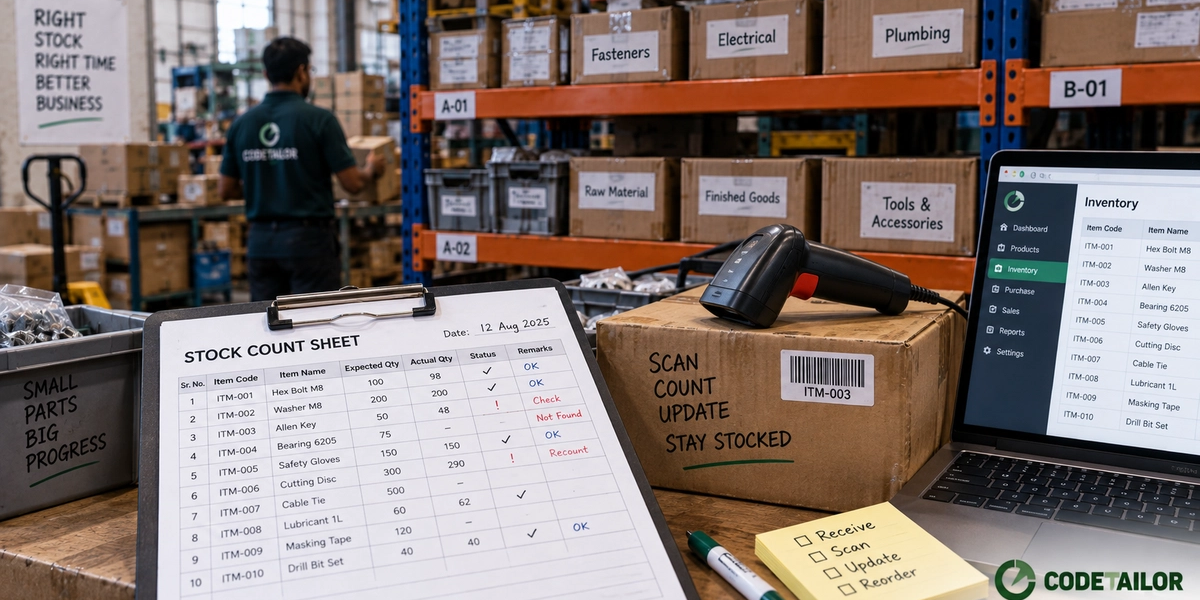
The number nobody trusts
Ask most businesses what their stock figure is and you get two answers: what the system says, and what they think is actually there.
The gap is the whole problem. Once people stop trusting the number, they stop using it — purchase decisions get made by walking to the godown and looking, and the software becomes a place where entries are recorded after the fact for the accountant's benefit.
New software does not fix that on its own. It fixes it only if it fits the way material actually moves, which is where the buying decision should start.
Start with the movements, not the features
Before looking at any product, write down every way stock enters, leaves or changes inside your
business:
- Goods received against a purchase order — and goods received without one
- Issues to production or to a job
- Returns from a customer, returns to a supplier
- Damage, expiry, shortage found at count
- Transfers between godowns, or between racks
- Samples, free replacements, material lying with a job worker
That last group is where systems usually break. Almost every product handles a clean purchase and a clean sale. The question is what happens when material sits at a job worker's premises for three weeks, or when a customer returns two of five pieces.
Any product you evaluate should be tested against the awkward movements, not the obvious ones.
What genuinely matters
Speed of the common transaction. The receipt and issue screens will be used hundreds of times a day. If one takes fifteen seconds too long or needs a field nobody has, people batch them up and enter them later — and stock is wrong all day, every day.
- It works where the material is. A system that can only be used from an office computer means someone writes on paper in the godown and types it in afterwards. That delay is where the discrepancy is created. A phone or a handheld scanner at the rack is worth more than most feature comparisons.
- Barcodes, if the volume justifies them. The value is accuracy more than speed. Typed item codes produce wrong-item errors that are almost impossible to trace later, because the entry looks perfectly valid.
- Honest handling of partial and pending. Half a purchase order received. A sales order picked but not dispatched. Material issued but not consumed. If the system can only represent completed transactions, staff will invent workarounds and the workarounds become the real system.
- Reports someone will actually open. Not fifty reports. Three or four: what is below reorder level, what has not moved in ninety days, what the count found last time, and stock value by category. Slow-moving stock in particular is where small businesses find money they did not know was tied up.
- Someone else's system can read it. Accounts needs the valuation. If getting it there means retyping, you have added a job rather than removed one — see why systems talking to each other matters more than which system you pick.
What matters less than the sales demo suggests
Multi-warehouse support, if you have one godown. Multi-currency, if you sell in rupees. Demand forecasting, before your historical data is trustworthy — a forecast built on inaccurate stock history is confident and wrong.
Mobile apps that only show dashboards. The useful mobile feature is entering a transaction where the material is, not reading a chart on the way home.
The part that decides everything
Stock accuracy is a discipline problem that software can support and cannot create.
Three habits do most of the work:
Enter the movement when it happens. Not at the end of the shift. Every hour of delay is an hour where the system is wrong and someone might act on it.
Count regularly, in small pieces. A full annual stock take finds a large discrepancy you can no longer explain. Counting a few racks every week finds small ones you can still trace to a cause.
Give the godown a reason to care. If the storekeeper gets nothing from the system except more typing, accuracy will decay. If it tells them what to pick, where it is, and stops them from issuing material that is already reserved, they will defend the data.
Any product that makes those three easier is a good product for you, whatever its feature list says.
Buy or build
Buy first. There are capable packaged options and the ordinary case is well served.
Build when the material flow is genuinely unusual — heavy job-work movement, grade or lot based pricing, a conversion process where what comes out is not what went in — or when inventory has to live inside a larger operations system you already run.
The same test as ERP applies: if the mismatch is central to how you make money, build the narrow piece around it. If it is unfamiliarity, configure and move on.
What to do next
Take the list of movements from the start of this post and run it against whatever you are considering, including whatever you use today. The awkward ones will tell you more in ten minutes than a week of demos.
If several of them have no clean answer, send us the list. More on inventory systems
we build.
If you also sell online, the same stock has to be right in two places at once, and the platform you sell on decides how hard that is — custom, Shopify or WooCommerce.