
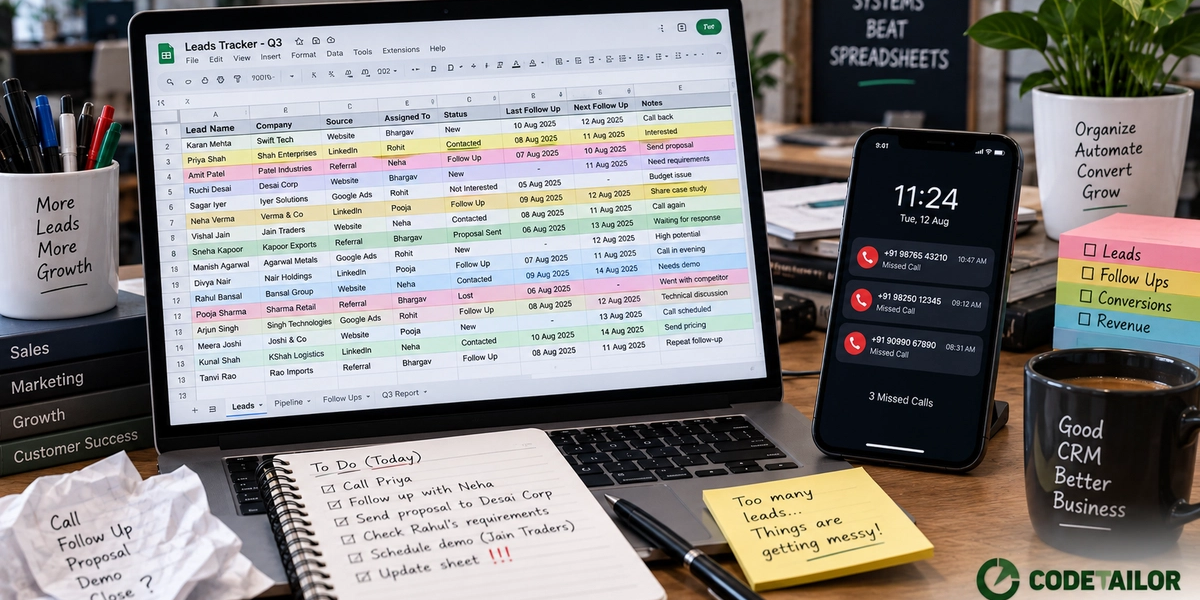
The spreadsheet is not the problem yet
A sheet with columns for name, phone, what they asked about, and when to call back is a perfectly good sales system for a business doing a handful of enquiries a week with one person handling them.
It costs nothing, everyone can use it, and it does not need a rollout.
Anyone telling you that is unprofessional is selling something. The spreadsheet stops working for specific, recognisable reasons — and until those reasons appear, replacing it is a project with no return attached.
Here is what those reasons look like.
Signal one: more than one person touches it
The moment two people are entering enquiries, the spreadsheet starts losing things quietly. Someone has the file open, so someone else works on a copy. Two rows for the same customer, updated differently. A row deleted by accident and noticed three weeks later. Nobody can tell who spoke to this customer last, or what was promised.
Shared cloud sheets help with the file-locking part and do nothing about the rest. There is still no record of who did what, and no way to answer "what did we tell them in March".
Signal two: follow-ups depend on memory
The most expensive thing a small business loses is not a lead. It is a warm lead that went cold because nobody called back on the day they said they would. A spreadsheet can hold a follow-up date. It cannot chase anyone. It sits there being correct while
the date passes.
If you have ever discovered a serious enquiry that nobody contacted for two weeks, that is this signal, and it is the one that usually costs the most.
Signal three: nobody can answer basic questions
How many enquiries came in last month? Which source produced customers rather than just enquiries? What is the average time from first contact to order? Which stage do deals die at?
These are countable in a spreadsheet in theory. In practice they take someone an afternoon, which means nobody asks them, which means marketing spend gets decided on impressions rather than results.
Signal four: a person leaving takes the customers with them
Your salesperson resigns. Where is their history — what they promised, what stage each deal is at, which customers are annoyed and why?
If the honest answer is "in their head and their phone", you do not have a sales system. You have several private ones that happen to be in the same company.
This is the signal that turns CRM from a productivity purchase into a risk one.
None of those apply? Stay put
If it is one or two people, the volume is manageable, follow-ups are not slipping and you can answer the numbers questions — you do not need a CRM this quarter.
What is worth doing instead is making the spreadsheet less fragile. One agreed file. A column for who owns each lead. A next-action date column, sorted so today's calls are at the top. A calendar reminder that opens it every morning.
That is twenty minutes of work and it buys you a year.
Buy before you build
When the signals do appear, start with an off-the-shelf CRM. They are mature, cheap to trial, and solve the ordinary version of the problem well. Building a custom one is worth it in narrower cases:
- Your sales process genuinely does not fit a pipeline — quotation-heavy, technical approval stages,
dealer networks - The CRM must live inside a system you already run, so that an enquiry becomes a quotation becomes
a job without retyping - Per-user pricing means you are rationing access to the people who need it
- You need it in a language or on a workflow the packaged options handle badly
The tell is the same as with ERP: if the mismatch is central to how you win business, build. If it is a preference, configure and move on.
Why most CRM rollouts fail
Not the software. The deal.
A CRM asks salespeople to type things. If it gives nothing back to them — no reminders they wanted, no faster quotation, no fewer questions from management — then it is pure overhead on the person whose time you least want to spend on data entry.
So they fill it in on Friday from memory, or not at all, and within two months the CRM contains a worse version of the truth than the spreadsheet did.
Three things prevent that:
- Fewer fields. Every mandatory field is a tax. Start with the minimum that makes the system
useful and add only what someone actually needs. - Something back, immediately. Reminders that fire, a quotation that generates itself, a customer
history visible before the call. The system should make their day easier by the first week. - One person owns it. Not "the team". Someone whose job includes making sure it reflects reality.
What to do next
Count the four signals honestly. Two or more, and it is time. Fewer, and the spreadsheet has another year in it — spend the money elsewhere.
If it is time and you are not sure whether to buy or build, describe your sales process to
us. Most of the time we will point you at something off the shelf, which is a shorter
conversation than either of us expected.