Three vendors, three answers, all of them honest
Ask three development companies what to build your application on and you will hear Node, Laravel and Django, each argued convincingly. None of them is lying. They are each telling you what their team is good at, which is a more useful answer than it sounds.
The uncomfortable truth underneath is that for an ordinary business application — users, roles, records, reports, some integrations — the framework is one of the least consequential decisions on the project. The database design matters more. So does whoever writes it.
What the choice actually changes
- Who you can hire next year. This is the big one, and it is local. The pool of available developers for a given stack in Surat is not the same as the pool in Bengaluru, and it is certainly not the same as the pool on a global salary survey. If your vendor disappears, you need somebody in reach who can read the code.
- How the code is expected to be organised. Some frameworks are opinionated and hand you a structure. Others hand you freedom and a chance to invent a bad structure. For a business application maintained by a small team over years, opinionated is usually the kinder choice.
- What comes in the box. Authentication, admin screens, background jobs, migrations, an ORM, scheduled tasks. A framework that ships these saves weeks and, more importantly, saves them in a way the next developer will recognise.
- How it is deployed. Some stacks are trivially hosted anywhere; others expect a particular runtime or a long-running process. That decision reaches into your hosting bill, so make it with the hosting question open rather than closed.
What the choice does not change
It does not fix a badly modelled database. It does not make your reports fast if the query is wrong. It will not save a project where nobody wrote down what the software is supposed to do.
And it does not decide performance. At the scale of a business application — hundreds or a few thousand users — every mainstream option is fast enough by an order of magnitude, and the slow page you will inevitably get is slow because of a missing index or an N+1 query, not because of the language.
How to choose a backend technology, in three questions
1. Who maintains this in two years? If you have an in-house developer, or plan to hire one, choose what they know or what is easily hired near you. If a vendor maintains it, choose what that vendor is genuinely strong in — a team writing in an unfamiliar framework to win a deal is a risk you inherit.
2. Is there one hard requirement? Most projects have none, and then the choice is free. Some have exactly one, and it settles the matter:
- Live updates to many connected clients — chat, tracking, dashboards that tick — favours a runtime built for many idle connections at once.
- Machine learning or data science running inside the application, rather than called over an API, points at Python.
- A large existing codebase, or an in-house team already fluent in something, outweighs every abstract argument.
- A packaged product you are extending decides it for you entirely.
3. Where does it have to run? A client with their own server, an on-premise deployment inside a factory, a specific cloud already in use for other systems. Practical constraints beat preference.
If none of the three points anywhere in particular, take the one your team writes best. That is not a cop-out; it is the highest-value input available.
The parts that cost more than the language
- The data model. Wrong here and everything downstream is patchwork. It is also the hardest thing to change once real data exists.
- Authentication and permissions. Nearly every business application eventually needs roles more subtle than admin and user — a manager who sees their branch only, an accountant who sees figures but cannot edit them. Retrofitting this is painful, so design it early even if you build it late.
- Background work. Reports, exports, emails, syncs. The first time a request takes ninety seconds because it is generating a PDF, you need a queue. Knowing that on day one changes the shape of the application.
- Migrations and the deployment path. How does a schema change reach production without downtime, and how do you get back if it goes wrong? Ask this before you agree a stack; a vendor without a clean answer has a bigger problem than their framework choice.
- Logs you can read when something breaks at 9 pm. Unglamorous, and the difference between a ten-minute fix and a lost evening.
What to ask a vendor recommending a stack
Ask why, and listen for whether the answer is about your project or about them. "It is what we are fastest in" is a good answer, honestly given. "It is the modern choice" is not an answer.
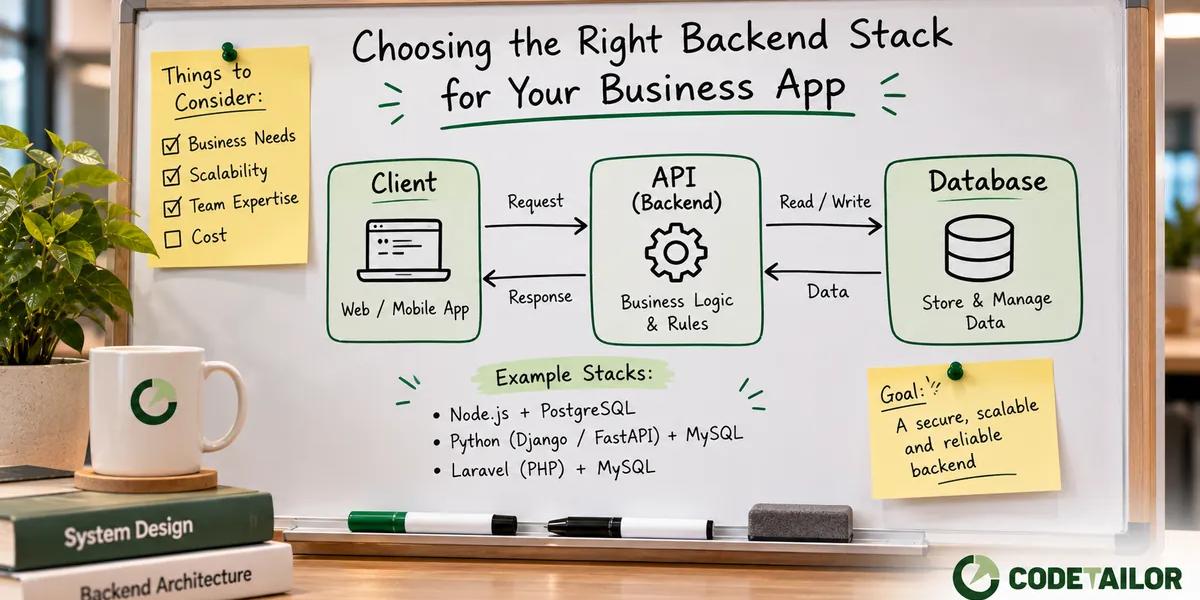
Then ask three specific things: who else can maintain this if you are unavailable, how the deployment and rollback works, and what the API boundary looks like. That last one is what keeps your options open later — the reasoning is in why systems should talk over APIs. More questions worth taking to a vendor are in how to choose a software development company.
What to do next
Write down your one hard requirement, if you have one, and who will maintain the software in two years. Those two lines answer the stack question more reliably than any comparison table.
If you would rather have someone else's opinion on it — including a straight "either is fine, pick the cheaper quote" — send us the requirement. More on backend and full-stack work.