Three quotes, three different platforms
A seller asks three companies to price an online store. One quotes Shopify, one quotes WooCommerce, one quotes a custom build at four times the price. All three are confident, and none of them asked what the seller sells.
That is the whole problem with this decision. Shopify vs WooCommerce vs custom ecommerce is not really a technical choice — it is a choice about who does the maintenance, what you pay every month for the rest of the store's life, and how unusual your business is.
Shopify vs WooCommerce vs a custom ecommerce store: what differs
Strip away the feature tables and three differences matter.
- Who keeps it running. On Shopify, they do. Updates, security patches, uptime and card compliance are somebody else's problem, paid for in the monthly fee. On WooCommerce, you do — or you pay someone to. A custom store is the same, with a smaller circle of people who understand it.
- What you can change. Hosted platforms trade control for reliability. Ninety per cent of what a seller wants is a setting or an app. The remaining ten per cent is either impossible or expensive, and you find out which after the business is already running on it.
- The shape of the cost. A subscription and transaction fees forever, against a larger amount now and hosting later. Neither is cheaper in the abstract. At low volume the subscription wins easily; the maths shifts as volume and order value grow, and shifts again if you need three paid apps to do one ordinary thing.
Where Shopify is the right answer
You sell a reasonably normal catalogue of physical products, you want to be live in weeks rather than months, and nobody in the business is going to look after a server.
That describes most first stores, and there is nothing embarrassing about it. A seller doing well on a hosted platform has a working business and a boring website. A seller with a beautiful custom store and no orders has an expensive website.
Treat it as the default. Argue your way out of it, not into it.
Where WooCommerce is the right answer
You already run WordPress and the content side matters — a blog that brings traffic, landing pages your marketing person edits without asking anyone. You want transaction fees off your back. And you have somebody, in-house or on retainer, who will apply updates.
That last condition is not optional, and it is where most WooCommerce stores go wrong. The platform is genuinely capable. Plugins left untouched for two years are what turn it into a liability.
When a custom store is actually justified
Four situations. One of them has to be true.
- Your pricing is not a number. Rates that differ per customer, slab pricing by quantity, prices that move with a yarn or metal rate, quotes negotiated per buyer. B2B sellers hit this constantly, and it is the most common honest reason to build.
- The catalogue is not a grid of products. Made to measure, configurable assemblies where the options change both price and lead time, fabric sold by cut length, rentals with date availability. If a product cannot be expressed as a set of variants, you will fight the platform on every listing.
- The store is a face on a system you already run. Your ERP holds the stock, the rates and the customer credit limits, and the website has to reflect them live. That is an integration project with a storefront attached — see why your systems talking to each other matters more than which one you picked.
- You are running a marketplace, not a shop. Several sellers, commission, split payouts, separate seller logins. Plugins exist and they are uniformly painful past a certain size.
Notice what is not on that list: wanting a particular design, wanting to own the code, disliking the monthly fee, or a competitor having a nicer site. Design is achievable on all three. The other three are feelings, and they cost more than they save.
The costs nobody puts in the quote
The build is the part everyone prices. The rest arrives afterwards.
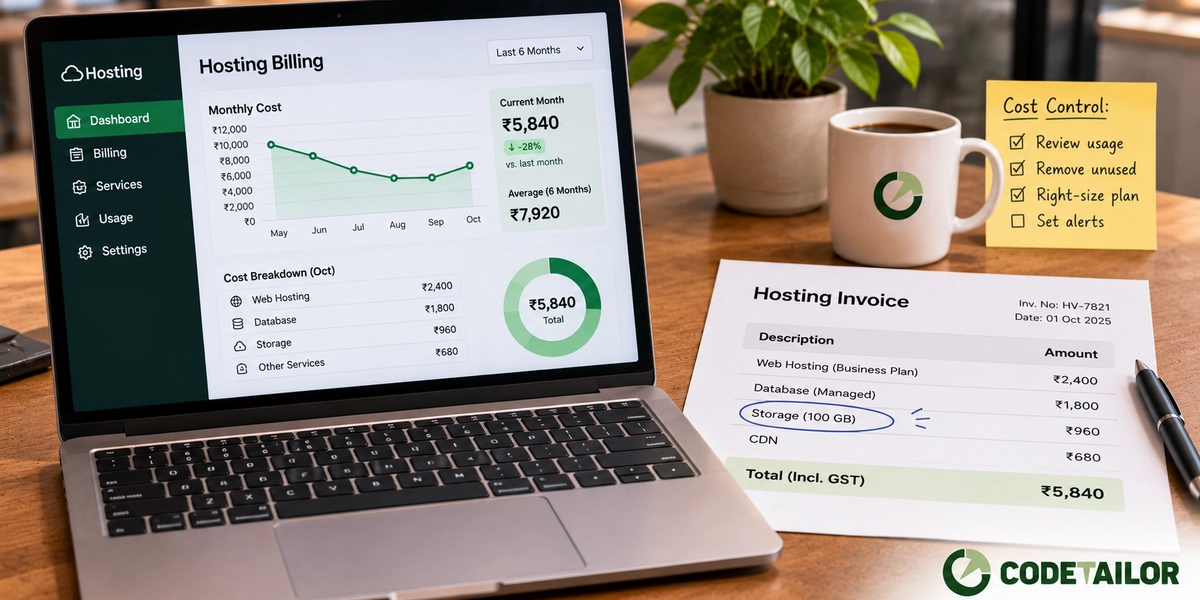
Payment gateway charges on every order. Product photography, which for a hundred SKUs is a project in itself. Cataloguing — somebody typing descriptions, weights, HSN codes and dimensions, always slower than promised. Shipping integration, and the pincode serviceability logic that comes with it. Returns, which need a process before they need software. And hosting, which on WooCommerce or a custom build is a monthly line for the rest of the store's life — where those bills come from.
Then the operational one that catches everybody. The moment you sell on your own store and a marketplace at once, two systems believe they own the same piece of stock. Deciding which is authoritative is a business decision, not a plugin, and it is the same discipline problem described in what to look for in inventory software.
The India-specific parts to check before you commit
Cash on delivery, and what the platform does when a COD parcel is refused at the door. GST-compliant invoices with the buyer's GSTIN captured at checkout, which matters the moment you sell to businesses. Weight and zone based shipping rates. Pincode-level serviceability. UPI at checkout, which now carries a large share of online payments in India and is where an unfamiliar checkout quietly loses orders.
All of it is solvable on all three options. Check it during the demo rather than after the launch, because two of them usually need a paid app on a hosted platform, and that changes the monthly maths.
Migrating without losing what you have
If you rank for anything today, treat your URLs as the asset. Keep product and category paths identical where you can. Where you cannot, map every old URL to the closest genuine equivalent — never to the homepage, which search engines read as a soft 404 and discount.
Export before you commit to anything. If a platform makes it difficult to take your customer list and order history out, that difficulty is a feature of their business model, and it is worth discovering before you depend on them.
What to do next
Answer one question honestly: is there anything about how you price, package or fulfil your products that a normal product page cannot describe? If not, start hosted, get orders flowing, and revisit in a year with real numbers.
If there is — and B2B sellers, manufacturers and made-to-order businesses usually find there is — tell us what the awkward part is. We will say whether a platform already handles it, including when that means you do not need us. More on the stores we build.